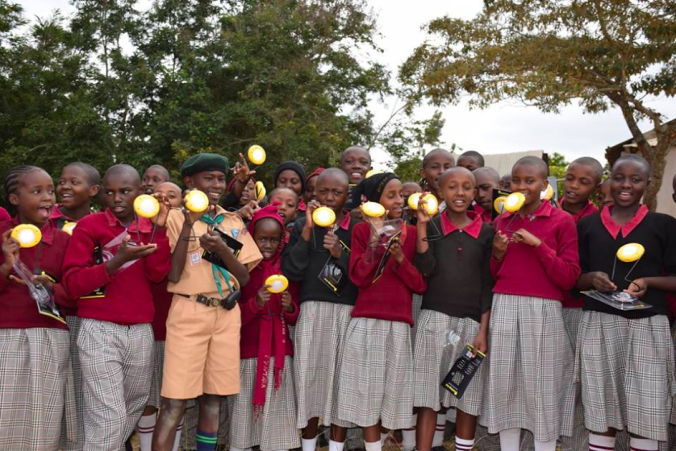
“Education is my Future”

MutuaA Difficult Realization

When Mutua was born, the last of five children, his mother’s age was already becoming a challenge to the family’s economic outlook. Her aging, arthritic fingers strained to pick coffee or sweep the floors of the homes of the family’s wealthier neighbors.

As Mutua grew, his mother worried about her youngest son’s slow development. On his mother’s lap, Mutua’s eyes brightened when she smiled. But, unlike when her other children were toddlers, Mutuadidn’t respond to her voice.

By Mutua’s first birthday, the family understood that he had been born deaf–the cause unknown.

Growing Up Deaf in Kenya

Growing up without hearing can be difficult anywhere, but in Kenya Mutua and his family faced many challenges. The few available health and educational facilities for deaf people are located in the big cities, far away from the rural area where Mutua was born. When strangers realized he couldn’t hear, Mutua saw their uncertain, fearful looks.

A priest in the Mutua’s church supported the family to send him to a special school for the deaf in a suburb of Nairobi, Kenya’s capital. Mutua’s father died before his son began his first day of primary school.

While at school, Mutua’s feelings of alienation began to fade. In a supportive environment, he flourished. He made friends easily with his big smile and warm personality. A natural runner, he won himself local fame by participating in a national athletic event while still in primary school. He began a habit of running every morning and evening.

As much as he loves sports, Mutua knows the importance of what happens inside the classroom. “Education is my future,” says Mutua.

‘Education is my Future’

Today, at 23, Mutua needs help to continue his high school education. His family cannot afford his school fees in order for him to graduate.

We first learned about Mutua from our partner Kenya Connect, one of our many excellent educational NGO partners. The School Fund partners with organizations like Kenya Connect, providing them an opportunity to connect donors directly with the students they serve. Meet all of our Kenya Connect students at www.theschoolfund.org/kenyaconnect.

‘We are so grateful to The School Fund for providing an opportunity for bright and needy students from our schools with an opportunity to realize their dreams by gaining secondary education and being resourceful people in the community,” says James Musyoka, Field Director & Director of Operations at Kenya Connect. “Through our partnership with The school Fund, we hope to promote literacy levels and reduce school drop our rates by a great margin.”

Posted in Uncategorized | Leave a comment

Students helping students, One-for-One

Clara BWThe faculty and students at the Khabele School in Austin, Texas believe that exceptional academics are only the start of a world class education. At this K-12 school, a well rounded learning experience includes teaching students to live their lives with courage and authenticity; a subject in which students are tested.

To graduate from Khabele, students must demonstrate proficiency not only in reading, math, and science, but also in five attributes of character: Well-being, Environmental and Cultural Awareness, Self-Generated Learning, Self-Expression, and Leadership.

We’re excited to announce a partnership with Khabele as a part of their commitment to character excellence and global awareness. This year, students at Khabele will help their peers in Asia, Africa, and Latin America to achieve the same opportunities they’ve been given by raising money to fund students’ school fees for a year.

One-for-one.

Perhaps you’ve heard of one-for-one programs where you can buy a pair of shoes and your purchase will enable a student in the developing world to receive a pair? Now imagine a school where each student is expected to raise enough money to send one of their peers in a low-income country to school.

That is exactly what Khabele is doing in its middle school and high school, and we are thrilled to be a part of it. This year, students may work in pairs to fundraise, but future incarnations of this program will be truly one-for-one, for a total of 230 students funded through The School Fund. Khabele students will also get the chance to learn more about their TSF partner by communicating directly through our online journals or through our topical discussion pages.

On average, every additional year of education increases incomes for students in low-income countries by about 10%. The students that Khabele funds this year will increase the lifetime earnings of their peers by more than a million dollars. That’s quite a service project.

To learn more about this program, or to get your school involved in a one-for-one program, email christi@theschoolfund.org.

Posted in Engagement | Tagged , , | Leave a comment

Practice What You Reach

Carolyn Malachi performing at The School Fund’s third birthday party in Palo Alto, CA.

This is a guest post from The School Fund’s friend, Grammy-nominated artist Carolyn Malachi, about our upcoming partnership to fund students’ education through sharing music.

We are what we practice. When we endeavor to greatness, the daily practice of innovation, perseverance, and collaboration is key. Playing college sports teaches you this. My basketball coach at Shepherd University was fond of a certain euphemism. Much to my chagrin, the phrase almost always preceded rounds of drills and sprints. “Offense wins games. Defense wins championships,” she would say. I disagreed with the sentiment, then. I still do. Individuals win games. Teams win championships.

For more than 115 million children in developing countries, getting an education is not a game. John Medo wants to be President of Tanzania. He comes from one of the poorest families in his community—his family of seven lives off of $45 a month. His school fees are $150 a year. The School Fund keeps John and hundreds of children like him around the world in school.

The organization, initially conceived as a Clinton Global Initiative University commitment, believes education is the most effective way for individuals to improve their own lives. Each year, school fees present an insurmountable barrier to students who hope to continue their education. The School Fund’s transparent, person-to-person internet platform links these students directly with funders thereby changing the way education development funding is both given and received.

My music inspires people to support their beautiful dreams with good information and solid effort. This is my passion, and I work at it daily. I am an independent artist. This means that I am not signed to a major record label, let alone an indie label. I have a growing team of fans, producers, managers, and musicians: my Tribe. We are partners in success.

Receiving a Grammy award nomination in 2011 ignited us all. We saw dramatic increases in website and social network traffic. Demand for my content (music and video) grew in new, exciting markets. While a curious world was watching, I was wondering. Could I add value to my content by offering an invaluable service to my global community?

“We teamed up with a single mission in mind, to use music as a means of educating students in developing countries.”

I needed an equally passionate and innovative partner. THE SCHOOL FUND… I heard the name while on a call with the Carmelita Group, an agency for social good, and a key player on my team. Their passion was evident. We teamed up with a single mission in mind, to use music as a means of educating students in developing countries. On March 8, 2012, we gathered in New York at the BCLC and United Nations Office for Partnership’s International Women’s Day conference, The Role of Business in Empowering Women. The experience fueled our curiosity and refined our approach.

At the time, I was writing a high-energy song called “Free Your Mind.” The refrain states, “Wherever you are, your mind put you there,” which is to say, how a person shows up in the world greatly depends on how they visualize themselves within it. We agreed this was an important message for The School Fund’s students and for my Tribe.

Just like that, the #IAM Campaign was born, and I got the partner of my dreams.

“You can change the world with a strong partner.”

You can change the world with a strong partner, and you may first notice the changes within your core team. The “Free Your Mind” song and video came to life this summer in Washington, DC. Music producers Marcus Marshall and Silvio Delis put their hearts into the song. The same goes for the Taratibu Youth Association and SunChase Media. Both groups worked diligently to execute the music video. We filmed over the course of three weeks, five, four-hour sessions, and several locations.

Earlier this month, The School Fund and I took the “Free Your Mind” song and the message of the #IAM Campaign to Silicon Valley. Audiences at Google, Chegg, and even the School Fund’s birthday party rejoiced when Matt Severson, President, shared the news. They danced when I performed the song. This partnership makes it easy for people to change the world while getting something they love, good music.

On December 6, the music video will make its debut at the BCLC Citizens Awards. What makes this video so special is that, for every view it receives, one hour of class time will be donated to students in East Africa, courtesy of The School Fund’s corporate sponsors. Our goal is to provide 10,000 class hours per month for six months. I am invigorated by the possibilities.

The BCLC Citizens Awards’ Best Partnership category recognizes 10 champions of change, five teams in pursuit of the possibilities. This is a people’s choice award. Last year, nearly 45,000 people voted to select W.W. Grainger Inc. and the American Red Cross as the Best Partnership. Click here to review this year’s finalists. Root for your favorite team and tell us what you think of their stories.

Interested in joining the #IAM Campaign? Send an email to share your interest.


Posted in In The News, TSF Updates | Tagged , , , | Leave a comment

Photo journey: TSF in Tanzania and Kenya (Part 2)

During our trip to Tanzania and Kenya in June, we met with students, partners, and made time to have a little fun. Here is the second installment of photos from that trip. Enjoy!

Pulling into the bus stop in Iringa, Tanzania. © Alessandra Hartkopf

In Wamunyu, Kenya, we were treated to an assembly with the whole school. Students brought their own chairs to the outdoor gathering space and performed songs before the speaking began. © Alessandra Hartkopf

Our after school program in Iringa, Tanzania empowers students to learn from one another, as well as the adults they’re used to hearing. Our “Technology Ambassadors” here help students in our program learn how to use the internet.

At Neema Craft Café in Iringa, Tanzania, a student performs in a talent show to raise money to build a jungle gym at his school. © Alessandra Hartkopf

Some of the girls in our after school program in Iringa, Tanzania wait anxiously for class to begin. © Alessandra Hartkopf

We took some time to visit the elephant orphanage in Nairobi, where caretakers feed baby elephant milk during their twice-daily parades. © Alessandra Hartkopf

Posted in developing world, TSF Updates | Tagged , , , , | Leave a comment

Photo journey: TSF in Tanzania and Kenya (Part 1)

This summer, TSF returned to its roots in Tanzania, where we support 75 students with scholarships. The goal for that trip was to set up a pilot after school program for our 40 students in Iringa, Tanzania.  In Tanzania, where class sizes can often exceed 100 students : 1 teacher, collaborative learning is rare. Our after school program aims at improving our students’ quality of education and building leadership skills. The program is using small class sizes, peer tutoring, and student led lessons to help our scholarship recipients succeed in school.

After two weeks in Tanzania we travelled north to Nairobi and the surrounding towns where we met with some of our partners and scholarship recipients. We were treated to singing, dancing, and lots of discussion with our brilliant Kenyan students, many of whom we were meeting in person for the first time. Check out the first installment of photos from that trip below!

The walk up to Ganglionga Rock in Iringa, Tanzania. Ganglionga is a favorite among locals and tourists for its spectacular views of the small city. © Alessandra Hartkopf

In Thika, Kenya, our partner Agape Mercy Children’s Center runs an orphanage supporting children from toddlers to twenty year olds. The children consider themselves siblings. We ate the East African staple, ugali, with the whole family for lunch.       © Alessandra Hartkopf

When the leaders of TSF partner organization, Flying Kites, were choosing a location to build their orphanage, the question that drove them was: “Where would I want to live?” The location, atop a hillside in the Kenyan highlands in Njabini, is breathtaking and the kids who live there are some of the happiest we’ve ever met. Here, a student washes her socks after school.                     © Alessandra Hartkopf

In the Kibera slum in Nairobi, Kenya, about one million people live in an informal settlement the size of Central Park. ¬¬Residents have limited access to sanitation, clean water, and other government services like police and fire protection. French street photographer JR created this art installation on the tops of roofs in Kibera.
© Alessandra Hartkopf

TSF partner, Children of Kibera, in Kibera, Nairobi, Kenya helps high achieving students from slums pay their way through prestigious boarding schools and eventually through University. Children of Kibera also runs a small, quality primary school in Kibera where we met this student.
© Alessandra Hartkopf

Posted in developing world, TSF Updates | Tagged , , , , , | 2 Comments

The School Fund Launches: Discussion Pages

High School Fellow from Palo Alto, Clara Chang talks to TSF student, Tunu Shaibu in Iringa, Tanzania. We’re excited to give students the opportunity to engage in dialogue online through our Discussion Pages.

The School Fund is happy to announce the launch of our Discussion Pages! Discussion Pages are a dedicated education space and open forum where students can engage with their peers about topical issues with global relevance. The first topic for discussion is “Water.” Students will use discussion pages to learn about water issues through online videos and resources, answer questions and start thinking on our storyboard, and engage in dialogue on our open forum.

Three schools in Tanzania, and one school in the US are partnering with The School Fund to build a curriculum that uses Discussion Pages to enhance lessons about global issues. This fall, these students will follow a curriculum centered around The School Fund’s discussion pages to engage with these issues through classroom discussion and activities, then build knowledge by asking questions and sharing information with their peers online through direct dialogue. One of the first activities will be for all students to keep a “Water Log” tracking the amount of water they use in a day and share their results online.

Based on the experiences and suggestions of these pilot schools, we will continue to build the Discussion Pages to ensure they are relevant to students’ in-class experiences. The ultimate goal is to enhance and extend students’ knowledge of global issues, and allow students to learn firsthand about how global issues have local impacts.

Discussion Pages topics will change periodically as student interest dictates. For a schedule of all the discussion page topics in 2012, please email Christi at christi@theschoolfund.org. The next topic in line for discussion? “Education”

Do you know a student, teacher, or school that could be interested in discussing Water or Education in an online forum with students in Africa and the US? The forum is open for all to join the discussion, and we encourage individuals and schools to jump in!

If you’re interested in shaping the direction of the Discussion Pages by becoming a pilot school or want to learn more about classroom activities to incorporate Discussion Pages into your lessons, email christi@theschoolfund.org to learn more.

Posted in Uncategorized | Tagged , , , , | 1 Comment

Life in their hands

Students listen to local leaders explain the importance of hard work at the reception for the launch of Maisha Mikononi Mwako (Life in your hands).

Written by Lee Marcus, a student at the University of Pennsylvania who is working with The School Fund in Tanzania for the summer of 2012.

Students began to file into Neema Craft Café on Sunday at around 1:30 PM.  “Mambo,” I said, handing each of them a TSF t-shirt. The room was set up for the launching of Maisha Mikononi Mwako (Life in your hands), The School Fund’s new after school program for 31 secondary school students in Iringa, Tanzania. The program aims to give students the tools they need to succeed in school and in life, providing them with academic support and technology training in preparation for high stakes Tanzanian National Examinations.

At Neema Craft Café, the guest of honor had arrived, five media representatives were on hand, and much of The School Fund Community in Iringa was present – headmasters from Lugalo, Ummu Salama, and Miyomboni Secondary Schools, Iringa Region Education Officer Mr. Joseph Mwinyikambi, Iringa District Education Officer Mr. Seme, and of course our students and their families.

Each of these individuals spoke to our students and their families, urging them to take life into their hands. This is a chance, said Principal Muhammed of Ummu  Salama Secondary School, to take life into the palm of your hand, where you control what you can achieve. This is your responsibility, your chance to excel in front of adults that believe in you, said Mr. Benjamin Kabungo, headmaster of Lugalo Secondary School. Madame Ramlah, headmaster of Miyomboni Secondary School, was the last to speak, and waited for parents and other community members to leave. “This is your opportunity, to be disciplined, to work hard,” she said, candidly. “Take it.”

The students arrived for their first day of Maisha Mikononi Mwako, timetables in hand. Students in forms 1 and 2 had English class, in which Mwajuma Abdallah explained in detail the nuances between the definitions of the words “request” and “ask.” One classroom over in form 3, students took a diagnostic test in Kiswahili grammar, language, and literature. Mr. Nkungu took the examinations home

in a folder for marking and analysis. Over in form 4, Hekima Mhole shaded the region on a coordinate plane that depicts the different combinations of mangos and oranges he could buy. The energy and positivity was contagious.

At the end of the day, students filed out of classrooms, looking as if they had just been pushed by exceptional teachers. Some of the form 3 boys pounded me with clenched fists. I felt the energy, the life in their hands, a powerful feeling that made all of us smile, because we are all in this together. Students and teachers believe in each other, and that is what makes our aim, for all of our students to excel, possible.

Posted in developing world, education, TSF Updates | Tagged , , , , | Leave a comment

Technology Training in Tanzania

Written by Lee Marcus, a student at the University of Pennsylvania who is working with The School Fund in Tanzania for the summer of 2012.

After finishing up preparation in The School Fund’s computer lab at Ummu Salama Primary and Secondary School in Iringa, Tanzania, I push the green curtains aside and wait for TSF students to arrive for Computer Camp.  It’s 15 minutes before the start of class.  I’m starting to get a bit restless, excited to teach students more advanced search techniques on Google.

Lee Marcus (right) and TSF student, Elizabeth Mlowe, explore the internet at The School Fund’s new computer lab in Iringa, Tanzania

I see Abel and Elizabeth strolling through the gate, side-by-side.  They are two exceptional students from Lugalo.  Abel, a naturally curious future scientist, is the oldest of four children.  Elizabeth, whose positive energy is contagious, lives with two siblings and her mother.  They are both independent workers and born leaders.

“Mambo,” I say, smiling as they walk into the classroom.

“Poa,” says Elizabeth.

“Fine,” says Abel.  “We came early to check our e-mail.”

I gesture to the computers, permitting them to log on to the internet, knowing that they would each have an e-mail from me.

The first class starts, and Abel and Elizabeth are on opposite sides of the room.  Elizabeth partners up with Debora, a student who used computers for the first time just a few weeks ago.  Abel, who is sitting at his own computer, squirms to the edge of his seat, leaning over to the right to point at something on Martha and Kandida’s computer screen.  He rapidly explains something in Swahili, and Martha and Kandida nod in understanding.

Meanwhile, Debora is moving the mouse from the middle of the laptop’s monitor to the Google Chrome icon.  Elizabeth says, “Double click,” and Debora, smiling, clicks twice, but only manages to highlight the text of the icon.  “Haraka kidogo [a little faster],” suggests Elizabeth, and Debora manages to open up the internet browser.  The two change the website to http://www.google.com, taking turns typing.

…………..

I have observed classrooms at Ummu Salama and Lugalo Schools.  Learning often happens in rows, with students learning independently of their peers.  The teacher is at the front, speaking.  The students are at their desks, listening, or answering the teacher’s questions.  The only activities that I have seen happen together are on the netball or football fields.

But in Technology Camp, students have taken time to adapt to different classroom norms.  On the first day, students seemed surprised to be asked to turn to a neighbor and discuss what the purpose of a CPU is.  However, as students began to become more comfortable working together, they started to rely on each other, ensuring that all are learning.

From the perspective of an teacher, building a strong learning community is important.  But watching students begin to build one themselves is every educator’s dream.  And this is what I have begun to see happen in Iringa.

Posted in education | Tagged , , | Leave a comment

A Visit to the Kibera Slum

Written By Sandra Hartkopf, TSF VP of Operations

“Can you see my house?,” Deborah Otieno asks me as we look over the sprawling Kibera slums from the still active railroad tracks.  I look over the many homes indistinguishable except for a few pairs of haunting eyes, remnants of a photographic art installation completed three years ago.  Locating the route we took over self-constructed wooden bridges, which merge dust and trash paths over streams of raw sewage, I am able to make a guess.  “That one?,” I ask, pointing in the direction of some familiar laundry lines.  Deborah smiles and nods proudly, “yes, that one,” she says, taking hold of my hand.

Deborah is Erick Otieno’s mother, a student The School Fund supports in conjunction with the Children of Kibera Foundation.  Erick, along with his 6 brothers and sisters and three abandoned children his mother has taken in, call their 10 ft x 10 ft corrugated tin shanty, home.  25 minutes drive from Nairobi’s city center, the Kibera slum is the second largest slum in Africa and home to more than a million people in an area only as large as Central Park.  They have no running water; some have no toilet access, utilizing the streams that flow begrudgingly between their homes.  Their electricity is purchased from poachers, who illegally connect Kenya Electricity Company lines to Kibera homes.  Their water is tapped from the government’s main water line and sold back to the residents, only accessible from a few large water tanks on the slum’s outskirts.  The Otienos and their neighbors pay rent to landlords, who have illegally commandeered government land, offering rusting metal structures at monthly rates half of the average monthly income.  Deborah makes $45 a month, on a good month.

As Deborah begins to veer off in direction of church service, I say goodbye and thank her again for welcoming us into her home and sharing a little of her story.  Just minutes before, she had thanked The School Fund for helping to support Erick in school.  She encouraged us to continue growing to not only support her children, but the many other Kibera children who still dream of going to school.  Children of Kibera Foundation supports 46 secondary school students including the eight The School Fund partially supports, that’s a mere fraction of the hundreds of thousands of secondary school aged children who cannot afford their fees.

Deborah smiles at us with a wide, white smile before she disappears into a jubilant church service housed in another tin structure.  Similar welcoming smiles shine across the faces of the children we pass.  They ask, enthusiastically, “How are you?,” habitually answering “I am fine,” before we even have the chance.  While they may be some of the most impoverished people in the world, the warmth and kindness of the Kibera residents allow me to maintain some hope.  The same hope Children of Kibera perpetuates, too.  Its founders, who grew up in the Kibera slums, work tirelessly to improve the lives of more than 300 primary and secondary students.  Perhaps, with more men and women like the Children of Kibera staff, we may help the sisters and brothers of those 300 students, too.

Posted in TSF Updates | Tagged , , , , , | 1 Comment

Feeling Welcome in Iringa

Written by Lee Marcus, TSF Intern from UPenn

Mambo from Iringa!

As we walked off of the plane and through the gangway in Dar es Salaam, signs read, “Karibuni,” welcoming those visiting the country, and welcoming back those who live here.

We obtained our visas, were admitted into the country, and met by Joseph Ignas just outside the airport. “Karibu,” he said, and was surprised when I responded “Asante,” a word I had learned just hours before, my first use of Swahili. We were welcomed at the Blue Pearl, where we stayed overnight, welcomed onto the bus that took us on a ten-hour journey from Dar to Iringa.

As we disembarked the bus, two more people met us, the first faces that smiled at us in Iringa. Rashid, Headmaster of Ummu Salama Primary School, exclaimed, “Karibu,” and introduced us to others who also welcomed us. We settled into our new home, dropped off our belongings, and went to Sai Villa, where we were welcomed for a tasty meal.

Over the past few days we have met with many individuals. An organization called Global Outreach runs two computer labs that are accessible to eleven schools in the Iringa Region, including Lugalo. The Tanzanians who worked there welcomed us into their labs and showed us everything they have to offer. “Karibu,” we were told before we entered each room of their facility. “Karibu,” said a professor at Ruaha University who helped us find a space for the technology training camp that begins on Monday. “Karibu,” said the secondary school headmaster at Lugalo. “Karibu,” said the Deputy Head Master at Ummu Salama.

Never in my life have I felt respected at the level of sincerity that I have experienced in Iringa. I am more than excited for the opportunity to lead a technology camp that supports students in Iringa. On Monday, I will, too, say “Karibuni,” welcoming TSF’s students into our classroom, and our lives, just as so many have so kindly welcomed us into theirs.

Posted in TSF Updates | Tagged , , , , , | Leave a comment